AI-ready design systems — design.md, AGENTS.md, and code agents can read
Intunio builds AI-ready design systems for teams that want Claude, Cursor, and Copilot to produce code that looks like your product — not default tailwind.
Intunio is a design and development studio in Gothenburg, building AI-ready design systems for teams where agents (Claude Code, Cursor, Codex) write a substantial part of the interface code. We deliver a `design.md` spec, an `AGENTS.md` instruction file, and a first set of shadcn-based components committed to your repo, so the agent has everything it needs to build consistently from the first prompt.
Our starting point is many years of experience with token-based design systems at Emerson, Electrolux, and other industrial clients, reframed for a world where the code is no longer necessarily written by a human. Tokens are still the source of truth. Components still exist. The difference is in how the design system is packaged so an agent can read and act on it without plugin, export, or handoff.
Read the article that grounds this work: .md – a new standard for design systems?
When does your team need an AI-ready design system?
For teams where most of the code was written by humans who held the system in Figma, a classic setup is enough. But once agents start writing the code, the playing field changes. Three situations where this becomes urgent:
When a substantial part of the interface code is written by Claude Code, Cursor, or Codex
Agents have no memory between sessions. Without a design system that lives as a file in the repo, the agent reinvents solutions every time — the same colour appears in three shades, the same dropdown gets implemented three times with different ARIA attributes, typography drifts.
When you're building a new product with agent-driven development from the start
An early MVP built with Lovable or Cursor typically lacks design structure. Putting an AI-ready design system in place early is cheap; cleaning up afterwards is expensive.
When your existing design system isn't agent-readable
Tokens sit in Figma variables behind a plugin, documentation in Supernova, components in an npm package. Everything works for humans but nothing is directly readable by the agent. Result: the agent ignores the system and builds its own.
In all three cases the problem is the same: a design system that an agent can't read will feel as limited as a design system a developer can't read.
What we do
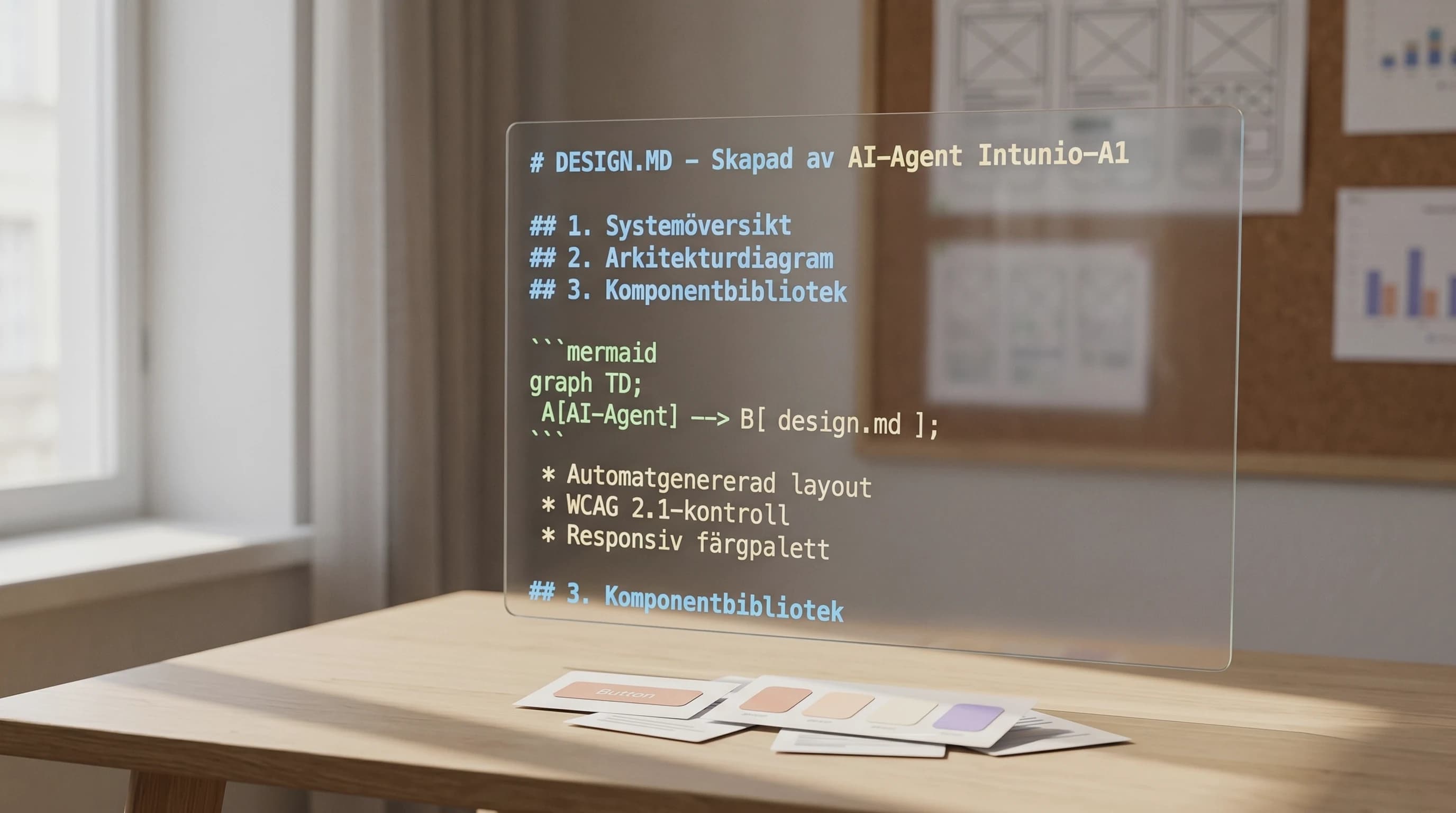
`design.md` spec: tokens (colour, typography, radius, spacing, motion) as YAML, plus component specifications (a primary button has this background colour, this radius, this padding) and prose with rationale
`AGENTS.md` / `CLAUDE.md` instructions: the file that tells the agent "read design.md first, import existing components, don't create new ones if they already exist, follow naming conventions"
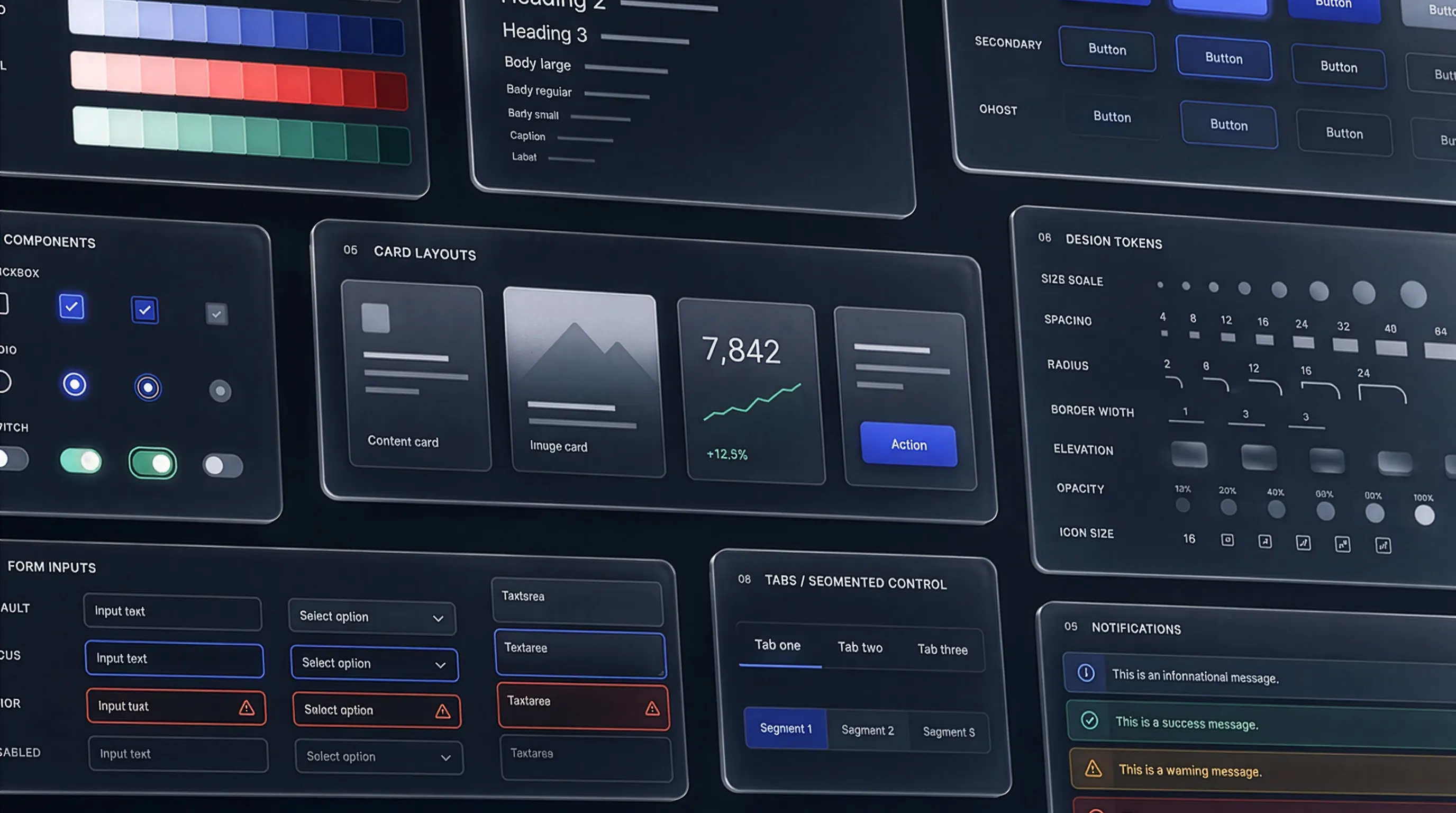
First shadcn-based components committed: we set up the foundation (buttons, form fields, dropdown, modal, navigation) in your stack with the right tokens, the right accessibility, the right prop model, so the agent has real references to import from
Token pipeline from Figma to `design.md`: when the designer changes a colour in Figma, we can export to YAML automatically, so the foundation stays in sync
Consistency model across sessions: three layers — tokens as source of truth, the file in the repo (not in the agent's memory), and an instruction file that points the agent to existing components
Iteration as the format evolves: Google Labs design.md is early, competing formats will appear. We track the shift and migrate your spec when needed
Common audiences are startups, AI-heavy product teams, and teams migrating from a Lovable/Cursor-built MVP into a more structured development phase.
Not just a new format — a different way of thinking about consistency
At Intunio we see `design.md` as a natural extension of token work we have done for years. It's not a break from how design systems are built; it's the same principles packaged so that an agent can act directly.
What really changes is how consistency is maintained. A `design.md` alone gives colour and token consistency, but not implementation consistency. Without the right structure around it, you get the same tertiary colour on buttons throughout the product but ten different dropdown implementations. That's why we always deliver three layers together: spec, AGENTS file, and a first set of committed components. Without the second layer the design system drifts, even when the colours are right.
Is this the right service for us?
This service fits when agents write a substantial part of the code, when pace is high, and when you want a lightweight model without heavy governance processes.
For industrial product families, multiple products and teams, long lifecycles, or heavy compliance requirements, our classic design system service is better suited. It gives a mature platform with Figma + codebase + Supernova documentation, governance and versioning, built to survive a change of design team or an organisational restructure.
The two services are not mutually exclusive. Many clients start AI-ready and grow into a classic model when the organisation and product portfolio require it.
How we work in an AI-ready engagement
Three phases, often delivered in two to four weeks:
Inventory
We look at your stack (Next.js, Vue, native, embedded), your current design (Figma file or product screenshots), and which agents you use. The result is a scope for what the spec and first components should cover.
Spec and first components
We write `design.md` with tokens and component specifications, set up shadcn-style components committed in your stack, and create `AGENTS.md` that points the agent in the right direction. We pair this with your Figma file if you have one, so designers can keep working visually while the agent works against the spec.
Validation with the agent
We run real prompts against your stack and tune the spec, instruction file, and components where the agent misunderstands. The result is a design system that actually works in your flow, not just on paper.
For clients who want to continue after the first delivery, we move into a rolling monthly engagement to maintain the spec, add components as new needs come up, and migrate to new formats when Google Labs or others publish updates.
What we offer
AI-ready design systems are a much lighter service than classic design systems. Four common engagements:
AI-ready for a single product (40–80 hours, approx. 40,000–80,000 SEK, delivered in 1–2 weeks): `design.md` spec, `AGENTS.md`, and 8–12 foundational components committed in your stack. Suitable for a startup with one product that wants structure from the start.
AI-ready for a startup stack (80–160 hours, approx. 80,000–160,000 SEK, delivered in 2–4 weeks): full `design.md` with more component specifications, integration with your Figma file if you have one, expanded `AGENTS.md` with per-folder rules, and 15–25 components. Suitable for teams with multiple products or a more complex stack.
Conversion: classic → AI-ready (80–160 hours, approx. 80,000–160,000 SEK, delivered in 2–4 weeks): you have a classic design system that isn't agent-readable. We extract tokens to YAML, translate the component library into spec form, and add `AGENTS.md`. Suitable when you want agents to work against an existing system.
Long-term maintenance (rolling monthly, from 40 hours/month, approx. 40,000 SEK/month): new components, adjustments to the spec, migration to new formats as they mature, support for teams using the system. Lighter maintenance than classic design systems because most of the work is done by the agent — we set and adjust the foundation.
For teams building or rebuilding a product alongside the system, we build it directly into the app development or product validation engagement. This is often a natural step two after validating a Lovable/Cursor-built MVP.
What does an AI-ready design system cost?
An AI-ready design system costs from approx. 40,000–80,000 SEK for a single product to approx. 80,000–160,000 SEK for a startup stack or conversion; long-term maintenance from approx. 40,000 SEK/month. Everything is billed at 995 SEK/h (our best price, with Team retainer) — the packages above show hours and price.
AI in our work
AI tools are included in the rate. We use Claude, Cursor, and Codex to write and iterate on the spec, generate component code, and test AGENTS instructions. It's our expertise working faster.
Common starting points
Three typical situations where a conversation with Intunio becomes relevant:
When a Lovable- or Cursor-built MVP needs structure
The product exists but the code is sprawling, the same components get implemented differently in different places, and new features just add inconsistency. An AI-ready design system gives the agent a shared foundation to build against going forward.
When your team starts using Claude Code or Cursor in earnest
You notice that without structure the agent keeps reinventing the same things. We set up a first `design.md` and `AGENTS.md` so the next session starts from the right state.
When your existing design system isn't agent-readable
Tokens in Figma variables, documentation in Supernova, components in an npm package. Everything works for humans but nothing for the agent. We convert to AI-ready format without throwing away what you've built.
In all three cases the result is the same: a design system the agent actually reads and follows, so consistency holds even when pace is high and humans don't see every commit.
Related content
Services
Insights
Frequently asked questions
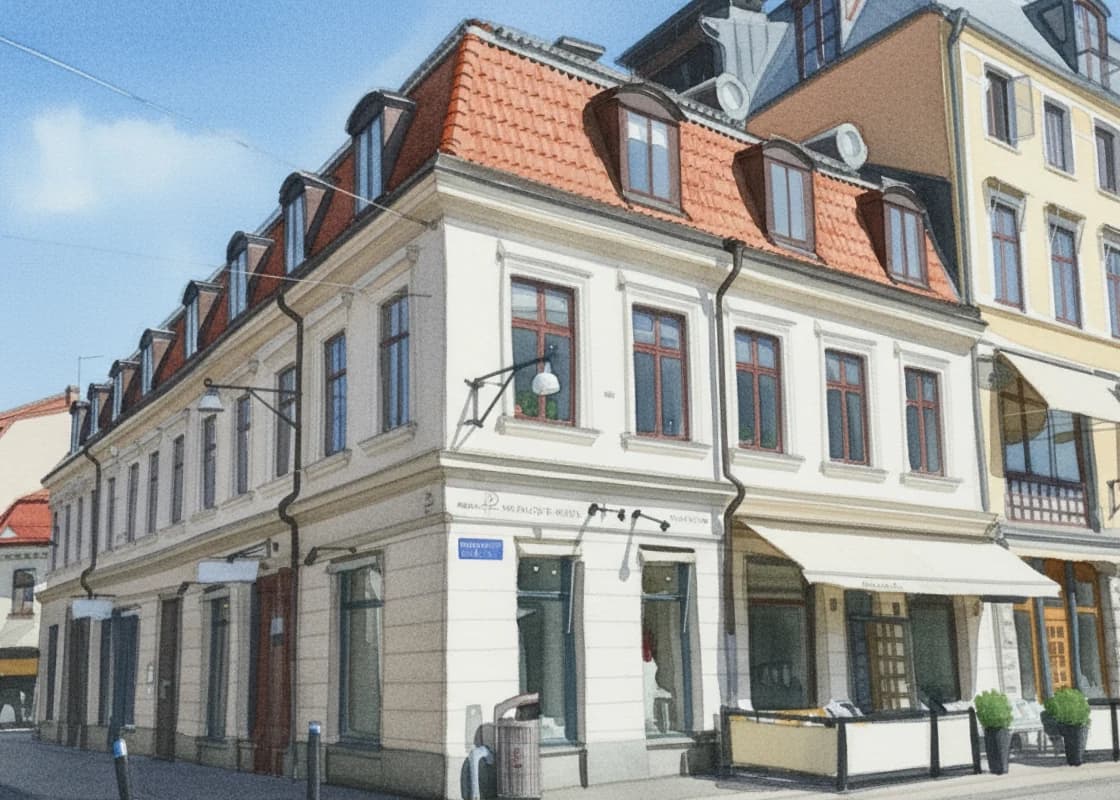
Intunio is based in Gothenburg, on Korsgatan 24 in the city centre. For clients in Gothenburg and Western Sweden, proximity is an important part of the collaboration. Workshops, check-ins, and informal meetings often happen on-site at your place or ours, which gives a kind of continuity that's hard to achieve with fully remote teams. It also matches our model: we become an extension of your team over time, not an external supplier.
Yes. Intunio has had continuous engagements with clients in Sweden, Europe, and North America throughout our history. We have particular experience with clients in the US and Canada, so working across time zones is part of our normal rhythm. For AI-ready design systems our way of working fits particularly well, since the entire delivery is digital — we need access to your repo and your Figma file if you have one. Workshops and check-ins happen over video, complemented by on-site visits where practical and valuable.
A classic design system is built for a world where humans draw in Figma and humans code against an npm package. An AI-ready design system is packaged so an AI agent can read the spec and act directly: tokens as YAML, components as specifications, instructions in `AGENTS.md`. Both rest on the same fundamentals (tokens, governance, consistency), but the package format differs. We help you choose which one fits based on your stack and how much of the code is written by agents. See our classic design system service for the more comprehensive version.
`design.md` is a machine-readable specification of a design system. It typically contains a YAML block with tokens (colours, typography, spacing) and component specifications, plus prose with rationale. Google Labs has published an open specification, and similar approaches are appearing in tools like Claude and Google Stitch. The format is early and will evolve, but the principle — a machine-readable spec an agent can act on directly — holds regardless of which exact format becomes standard. We track the development and migrate your spec when needed.
`AGENTS.md` (or `CLAUDE.md` for Claude Code) is an instruction file that lives in the repo and that the agent reads at the start of every session. It says things like "read `design.md` first", "import existing components from `/components/ui`, don't create new ones if they already exist", "follow this naming convention". Without it, the agent will read `design.md` if it finds it, but won't follow it consistently. With it, the agent becomes a disciplined part of the team rather than a tool that reinvents things every time.
Yes, we use shadcn/ui as the default starting point for React-based stacks. The reason is that shadcn components are source code you copy into your own repo, not an installed package. That means you own the code, can modify it for your tokens, and the agent has real files to reference. For other stacks (Vue, native iOS/Android, embedded) we use the equivalent pattern with your own committed components. We are pragmatic about tools — what fits your stack carries the most weight.
The likelihood that the exact `design.md` format changes is high, since it's early and several actors (Google Labs, Anthropic, others) are experimenting with different variants. That's why we always deliver with a clear token pipeline (Figma → YAML) and don't hard-code your spec against a single format. When the format evolves, we migrate the spec, not the entire design system.
AI-ready for a single product (40–80 hours) costs approx. 40,000–80,000 SEK, a startup stack or conversion (80–160 hours) approx. 80,000–160,000 SEK. Long-term maintenance from 40 hours/month costs approx. 40,000 SEK/month. Everything is calculated on the hourly rate of 995 SEK/h — our best price, with Team retainer. We provide an exact quote once scope is confirmed.
Both. We actively use Claude, Cursor, and Codex when we write `design.md`, generate component code, and iterate on `AGENTS.md` instructions. That means our delivery is faster and we can test the spec against the agent in real time while we build. it's our expertise working faster, not AI replacing the expertise.
Intunio Gothenburg
Intunio is a design and development studio based in Gothenburg. We help companies create digital products, apps, and systems that are easy to use and built to last.
For AI-ready design systems, we package tokens, components, and documentation so AI agents can act on them directly, always focused on what you control in your own repo.





































Want a design system that AI agents can read?
Tell us which stack you work in and what you want to build, and we'll propose a setup.