Tech demos — 3D graphics, hardware integrations, and prototypes for pitch and trade fair
Intunio creates tech demos that visualise complex technology — interactive prototypes that make the invisible understandable.
Intunio is a design and development studio in Gothenburg, building tech demos and prototypes for technology that's otherwise hard to see, understand, or communicate. Advanced 2D/3D graphics, hardware integrations, and interactive experiences that make the abstract tangible for pitches, trade fairs, and investor meetings.
Our strength lies in translating technical depth into visual expression. Industrial software, AI flows, hardware acting in the background, processes that engineers understand but no one else sees — that's where we make the invisible understandable. Designers and engineers work in the same team so the expression is grounded in how the technology actually works.
We build pitch demos for investor and sales meetings, trade fair demos that draw people to the stand, and advanced prototypes that show new technology in industrial, medtech, or automotive contexts.
What we do
Advanced 2D and 3D graphics: Three.js, WebGL, WebGPU, custom shaders, particle systems, and data visualisations that show technical depth in a way you can actually experience
Visualisation of processes and systems: digital twins, real-time data, 3D models of products and processes that make the abstract visible
Hardware integrations: sensors, physical products, real-time data from field units via BLE, MQTT, USB, or serial communication
Interactive storytelling: demos where the viewer discovers the technology by exploring, not just watching
AR and VR elements where they fit: WebXR experiences for showing something physical or spatial that doesn't fit on a screen
Pitch and trade fair support: scripted demo flows, reset between users, performance on the hardware actually being used
Demos built on a production-ready stack: when the idea gets the green light, the demo can evolve into a product without starting over
The industries we most often build tech demos for are industrial, automotive, medtech, IoT, and tech startups going to market.
Visualising technology that's otherwise invisible
At Intunio we build tech demos for technology that's hard to see, understand, or communicate without experiencing it. Industrial software deep in a process, AI flows where the complexity lives in a thousand small decisions, hardware acting in the background — things engineers understand but no one else sees.
Our strength is translating technical depth into a visual experience where the viewer actually feels what the technology does. Advanced 3D graphics, real-time data, and interactive flows aren't used as decoration but as a language for making the abstract tangible. That's where design and engineering meet for real: the designer understands what should be felt, the engineer understands what's actually happening, and together they build something neither would build alone.
Deep dive: Nira Dynamics
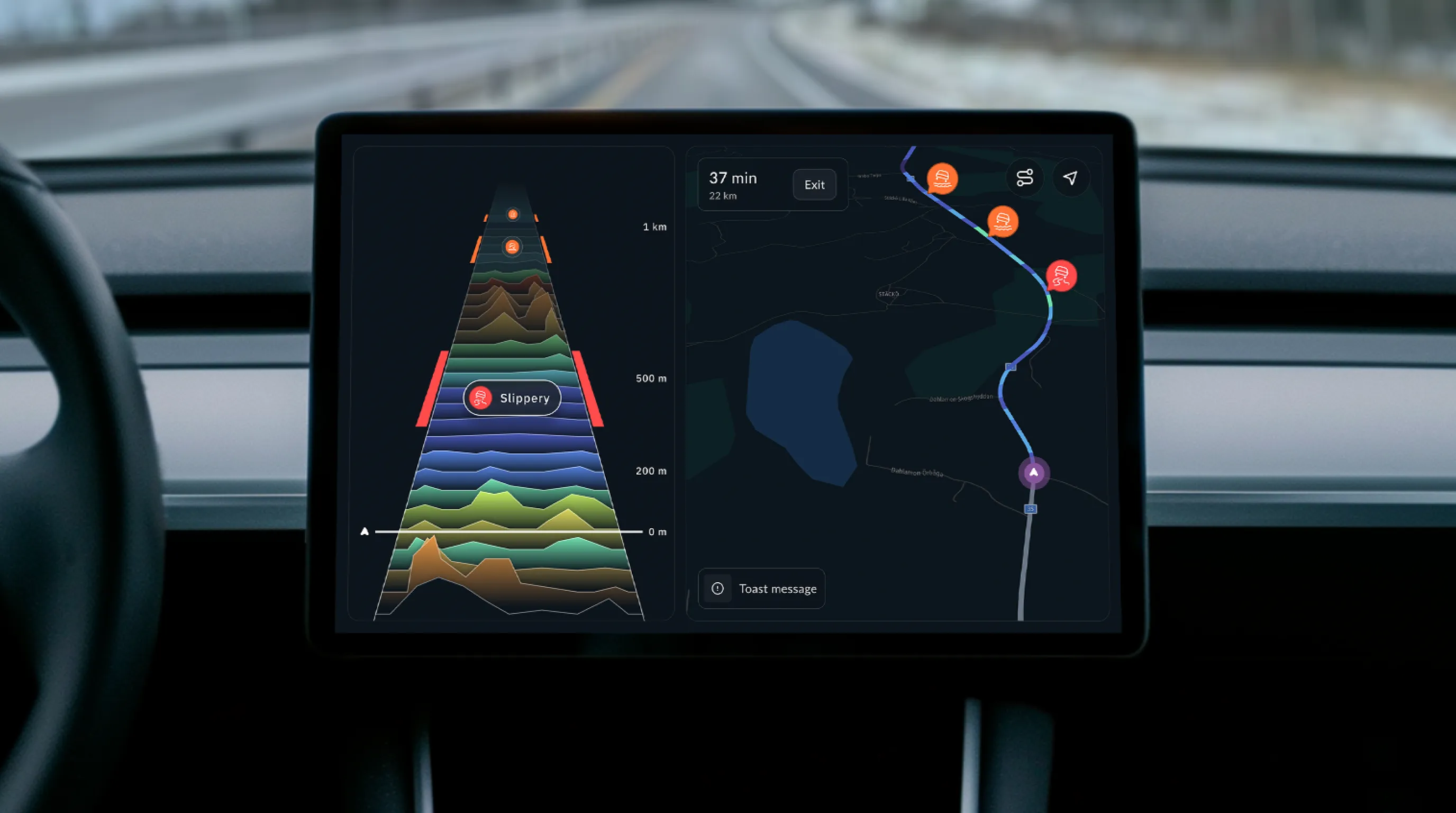
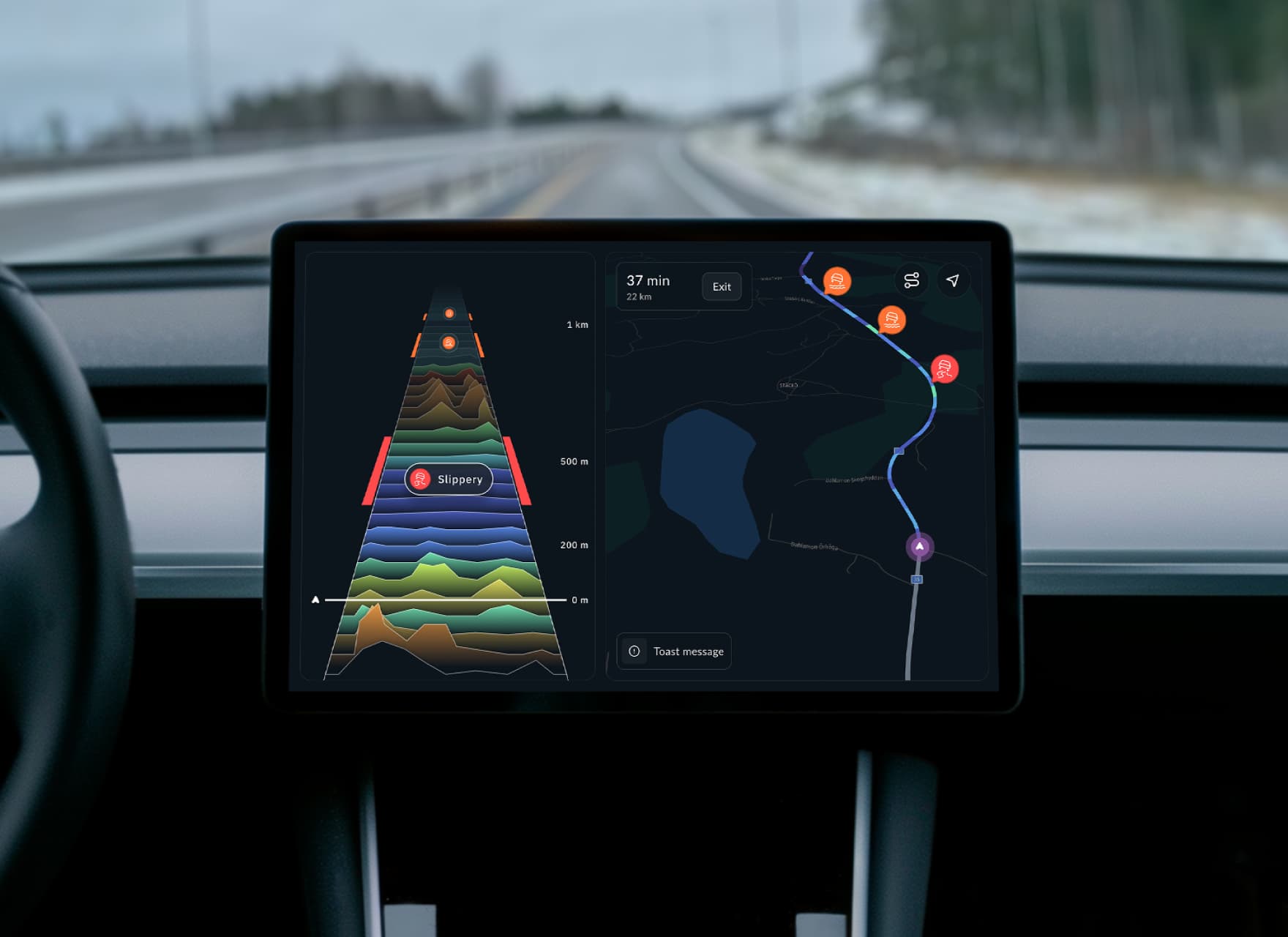
Nira Dynamics collects sensor data from millions of vehicles around the world and packages it into services about road conditions and tyre status. To showcase the services Road Surface Alerts and Road Roughness, we built a demo application for Android Automotive and Android tablets, with live data from Nira and GPS from the vehicle.
The biggest challenge was translating abstract sensor data into something a driver can feel and act on. We built a custom 3D visualisation of the Roughness data where procedurally generated graphics run directly on the device's GPU: each road segment gets a unique appearance where colour and height represent the level of roughness. The client app in Kotlin/Android, backend in Go, map integration via HERE Technologies — all on a stack built to hold up in demo mode at trade fairs and evolve into production.
See the full case: Nira Dynamics — tech demo for an innovative mobility company.
When a tech demo is the right tool
Three situations where a tech demo becomes relevant:
Before a pitch, investor meeting, or sales conversation
You have a complex idea or technology that's hard to explain in words. An interactive demo lets the listener see and feel the concept in minutes.
Before a trade fair or event
The stand needs something that draws people in and keeps them there. A well-built demo that runs a thousand times without breaking is the difference between a successful fair week and a stressful one.
When new technology needs to be visualised for stakeholders
Industrial or medtech technology that can't be shown in the field needs to be visualised digitally — for partners, customers, the board, or regulatory contexts.
How we work in a tech demo engagement
Three phases, often delivered in 2–6 weeks depending on scope:
Concept work
We understand what the demo needs to prove, for whom, and in what context. A workshop with your technology and product leadership, ideally with concrete examples from competitor or reference presentations. The result is a scoped demo concept — what's shown, what's not, how long a typical session lasts.
Design and technical prototyping
We design and build at the same time. Visual concepts (3D feel, interaction patterns, data visualisation) are developed in parallel with technical prototypes in Three.js, WebGL, or native, depending on what the demo requires. Early functional prototypes are tested against the demo goals.
Polish and expression
The chosen direction is developed into a demo-ready experience. The focus is on visual expression and storytelling flow — how the technology is portrayed so the viewer feels what we want to communicate. Resilience in trade fair or pitch mode (reset flows, performance, edge cases) is part of the work too, but it's not where the value is created.
For clients who want to evolve the demo into an actual product, we move into app development or web development engagements directly after demo delivery.
What we offer
Tech demos vary in scope depending on interaction depth, hardware integration, and visual complexity. Three common engagements:
Pitch demo (40–80 hours, approx. 40,000–80,000 SEK, delivered in 1–2 weeks): a fast interactive demo for sales pitch or investor meeting. Focus on visual impact and a tightly scripted demo flow. Suitable when you're going into a meeting and need a concrete demo to show.
Trade fair or event demo (80–160 hours, approx. 80,000–160,000 SEK, delivered in 3–5 weeks): a demo meant to run thousands of times on a stand or demo area. Includes reset flows, offline fallback, multi-touch or gesture support if relevant, and performance validation on the actual hardware.
Advanced prototype or production-ready tech demo (from 160 hours, from approx. 160,000 SEK, often 200–400 hours, approx. 200,000–400,000 SEK; delivered in 4–8 weeks): complex demo with 3D graphics, hardware integration, or AR/VR elements. Built on a stack that can evolve into a product. Suitable for new technology being shown to multiple stakeholders over time.
For clients who want to evolve the demo into an actual product, we move directly into app development or web development. Since the demo is built on a production-ready stack, the transition is smooth — nothing is discarded.
What does a tech demo cost?
A tech demo costs from approx. 40,000–80,000 SEK for a pitch demo to approx. 200,000–400,000 SEK for an advanced prototype; a trade fair demo lands at approx. 80,000–160,000 SEK. Everything is billed at 995 SEK/h (our best price, with Team retainer) — the packages above show hours and price. Since the scope of a tech demo is clearly defined, we also offer a fixed price.
AI in our work
AI tools are included in the rate. We use Claude, Cursor, and AI-based tools for 3D concept exploration, shader generation, and prototype iteration. That lets us explore more directions early and build faster once the concept is locked.
Common starting points
Three typical situations where a conversation with Intunio becomes relevant:
When new technology needs to be shown at a pitch or trade fair soon
You have a deadline, scope needs to land quickly, and the demo has to be ready on time without compromising on quality. We go from concept to demo in a few weeks.
When a technical proposition is hard to explain in words or images
Complex industrial software, a medtech application, or an AI product that needs to be felt before it can be understood. An interactive demo makes it tangible.
When a demo can become the foundation for an actual product
You want to show an idea to stakeholders and at the same time build something that can evolve once the idea gets the green light. We choose stack and architecture so nothing is discarded.
Related content
Projects
Services
Frequently asked questions
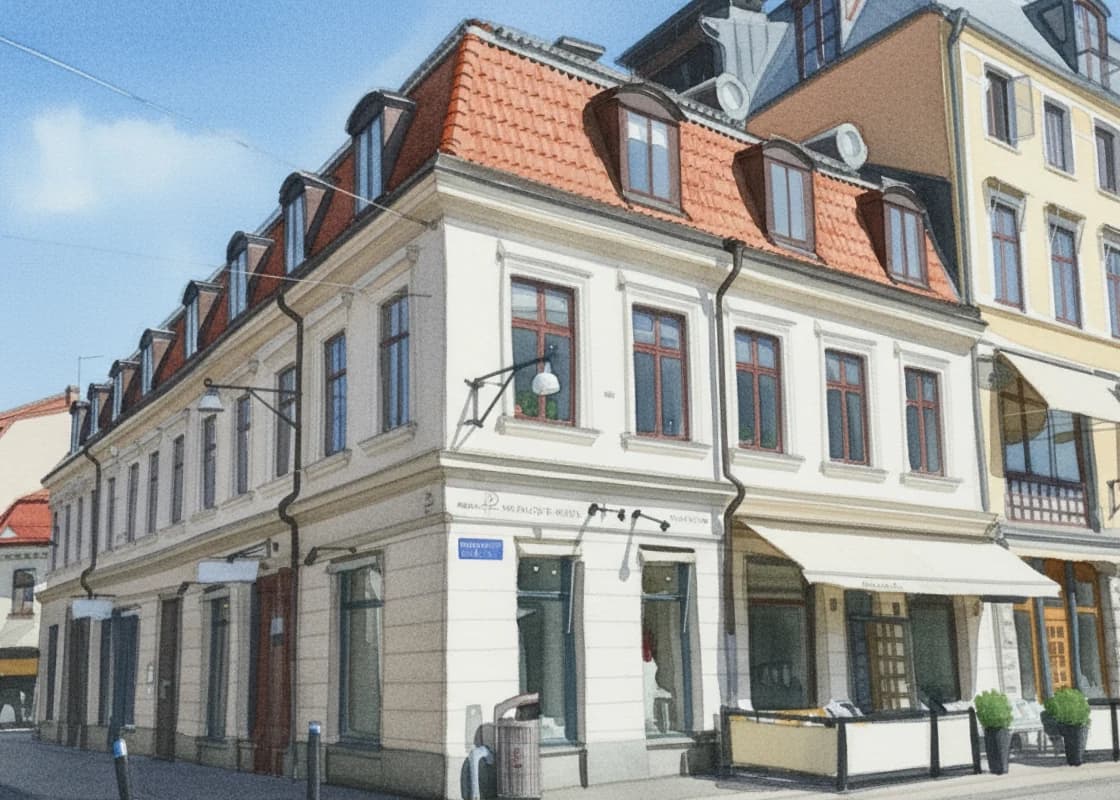
Intunio is based in Gothenburg, on Korsgatan 24 in the city centre. For clients in Gothenburg and Western Sweden, proximity is an important part of the collaboration, especially in tech demo engagements where concept and hardware discussions often work better on-site. Workshops and check-ins often happen at your place or ours, which gives a kind of continuity that's hard to achieve with fully remote teams.
Yes. Intunio has had continuous engagements with clients in Sweden, Europe, and North America throughout our history. We have particular experience with clients in the US and Canada, so working across time zones is part of our normal rhythm. For tech demos, concept work and technical development mainly happen from our office in Gothenburg, complemented by physical tests in the environment where the demo will run (stand, pitch room, field studio) when relevant.
For web-based demos we typically use Three.js, WebGL, WebGPU, and custom shaders for advanced graphics. For native demos we use Swift, Kotlin, or Flutter depending on platform. For hardware integration we work with BLE, MQTT, serial communication, and cloud APIs. AR/VR via WebXR or native frameworks where relevant. The stack is chosen based on what the demo needs to prove and where it will run.
A tech demo is meant to show an idea or technology convincingly in a short time. It doesn't need to be complete as a product, but must work flawlessly in its demo mode. An MVP is a first buildable product version meant to be tested with real users in production. Both can be built on the same stack, and a good tech demo can often evolve into an MVP. See pre-study and app development for MVP work.
We have experience integrating demos with sensors, physical products, and custom hardware via BLE, MQTT, serial communication, and USB. For industrial demos we often integrate with real-time data from field units or control systems. The physical integration side is designed together with your engineering teams, and we handle the software side.
Yes, this is one reason we build demos on a production-ready stack. Since we use the same technologies as in our app and web products, the demo can evolve without starting over. For clients who want to go directly from demo to production, we move into app development or web development as a natural continuation.
A pitch demo (40–80 hours) takes 1–2 weeks. A trade fair demo (80–160 hours) takes 3–5 weeks. An advanced prototype (160–400 hours) takes 4–8 weeks. Time depends on interaction depth, whether hardware integration is included, and the level of polish required. For trade fair deadlines we always build in time for field testing and adjustments in the actual environment.
A pitch demo for a sales or investor meeting takes 40–80 hours and costs approx. 40,000–80,000 SEK, delivered in 1–2 weeks. Calculated on the hourly rate of 995 SEK/h; a fixed price is often an option.
A trade fair or event demo takes 80–160 hours, approx. 80,000–160,000 SEK. An advanced prototype with 3D, hardware integration, or AR/VR lands at 200–400 hours, approx. 200,000–400,000 SEK.
We use Claude, Cursor, and AI-based design tools for concept exploration, 3D reasoning, shader generation, and prototype iteration. That means we can explore more visual directions early and build faster once the concept is locked. The creative core and the technical quality decisions are made by a human.
Intunio Gothenburg
Intunio is a design and development studio based in Gothenburg. We help companies create digital products, apps, and systems that are easy to use and built to last.
In tech demos, covering 3D graphics, hardware integrations, and prototypes for pitches and trade fairs, we work with design and development that meets your specific needs, always focused on quality and long-term usability.












Want to know more?
Tell us where you are today, and we'll get back to you with a proposal for the next step.